
By Robert Jessel, LGB Alliance Press Officer
The cardinal rule of PR is never to criticise journalists. But when a newspaper misleads its readers and encourages them to ignore the law, that principle goes out of the window. The risk of staying silent (and thus complicit) outweighs the risk of speaking out.
Which brings us onto Charity Times. This isn’t some upstart, click-hungry media brand; it’s been with us for over 30 years, runs a highly-regarded annual awards programme (now in its 27th year), and is recognised as the semi-official voice of the UK charity sector. It’s a must read for everyone in the industry.
But with reputation comes responsibility. First, there’s the requirement to be impartial, especially when dealing with controversial or hotly-contended topics. Then there’s the much more basic obligation not to mislead your readership, and thereby place them at risk of significant organisational and personal damage.
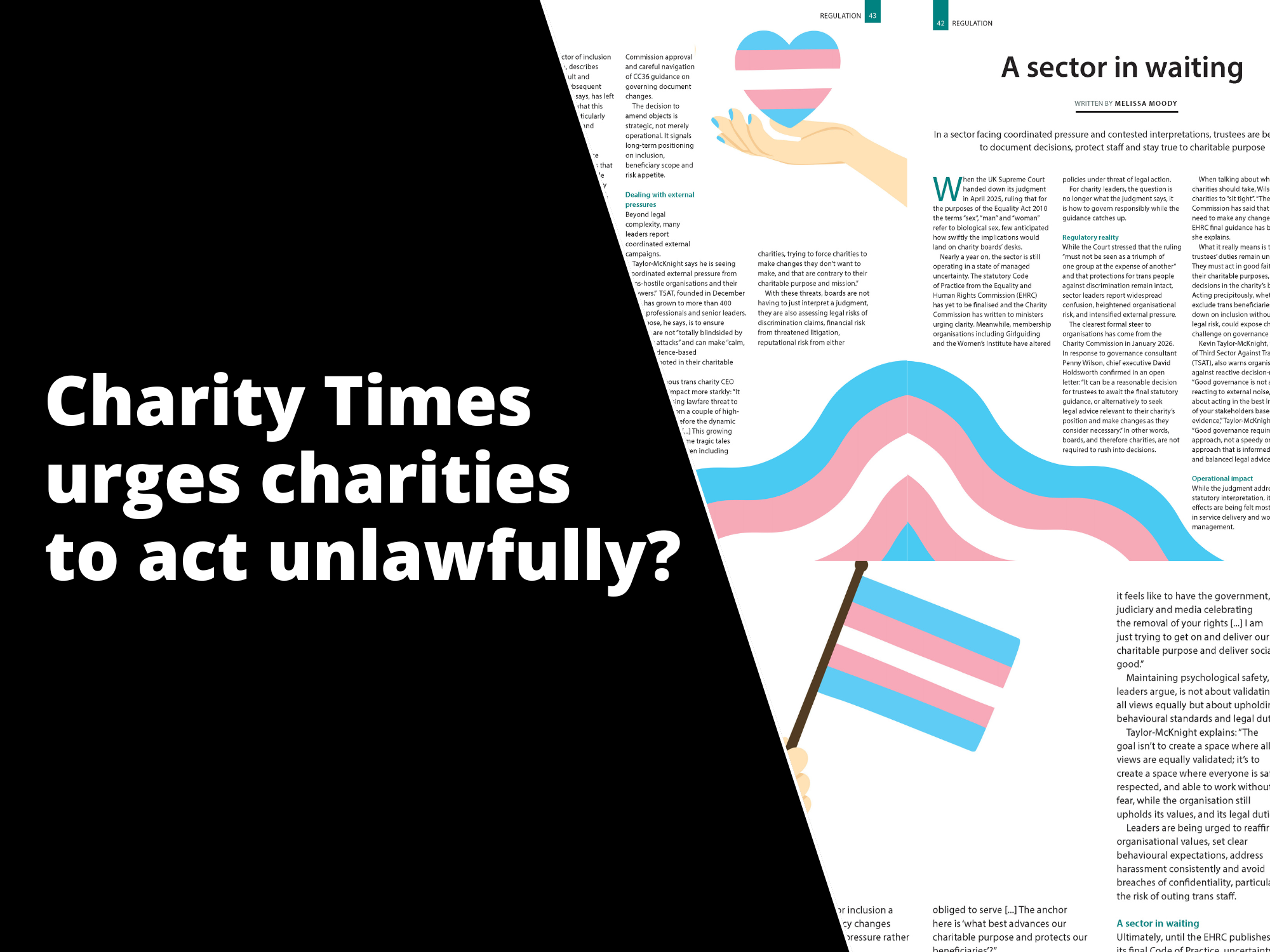
Charity Times provides the perfect example of a once-esteemed publication that has sacrificed its objectivity to gender identity ideology. This is seen most starkly in its Spring 2026 edition which ran an article titled ‘A sector in waiting — What impact has the UK Supreme Court ruling on sex and gender had?’
So far, so predictably tiresome: a media organisation captured by trans activists is hardly front page news. What rankles is the fact our CEO Kate Barker took the time to provide detailed answers to the journalist’s questions well in advance of publication. Remember, LGB Alliance was directly involved in the Supreme Court victory as one of the “Lesbian Interveners”, so Kate’s insight carries some weight.
We’re not precious about Kate’s quotes not making the cut; we’re alarmed about what was included. Take this insight from Kevin Taylor-McKnight, founder of Third Sector Against Transphobia (TSAT): “Good governance is not about reacting to external noise, it’s about acting in the best interests of your stakeholders based on firm evidence,” he opined.
External noise? Firm evidence? The actual Supreme Court not good enough for you, Kevin?
Compare this with Kate’s no-nonsense advice (reproduced in full below): ditch the external ‘diversity consultants’; study the Equality Act and the nine protected characteristics; don’t prioritise the rights of one group over another; and my favourite: “Start a debate. Allow all opinions to be aired. Lean into disagreements to find solutions. Stop being afraid of discussions.”
By failing to provide any useful advice on how charities can ensure they’re compliant with the law, Charity Times has crossed the line from journalism into activism. So this is no longer a matter of media relations, but one of whistleblowing.
Because Charity Times is mugging off its readers. As I wrote in my last (unanswered) email to the deputy editor, the longer charities ignore the judgment, the greater the risk of an employment tribunal. And it’s not solely a governance problem; it’s an individual one too, since any decision maker can be personally liable for breaching the Equality Act.
Trust in journalism has been declining for years; it won’t be restored while publications treat their readers as collateral damage in their pursuit of activism, disguised as reportage.
Charity Times — LGB Alliance answers to journalist questions
Date: Fri, 13 Feb 2026 at 11:31
Subject: Re: Leadership and Trans Inclusivity – LGB Alliance response
To: Charity Times
Thanks for your patience. The answers to your questions come from Kate Barker, CEO, LGB Alliance. I’ve also attached a high-res image in case you need. Any questions, please don’t hesitate to let me know.
All the best,
Robert
How do you interpret the Supreme Court’s ruling, and what clarity does it provide for charity leadership?
The ruling could not be clearer. Sex is binary and immutable. The word ‘woman’ means biological woman and the word ‘man’ means biological man. Those who claim it is complex or difficult do so because it is in their interests to obfuscate.
Whether or not they are prepared to admit it publicly, many charity leaders are hugely relieved that the ruling provides their organisation with an ‘off-ramp’ from the extreme ideological capture engineered by a handful of determined gender activists within their ranks.
Those extremists have silenced dissent but do not represent the majority view. They’ve created an internal culture which is fearful and vituperative and that means really good people have left the sector rather than submit to it.
This is an opportunity for a fresh start and leaders should embrace that.
What decisions do charity leaders now need to make in response, and why are these decisions challenging?
Charity leaders need to be led by the law and they need to make it clear to everyone in their organisation that they will do so. It will be challenging because a small number of individuals will feel they are being unfairly treated. It’s time for leaders to stop being timid and have honest conversations with those people about the legal framework. You might find they have useful solutions to suggest and that their insights can help inform better and fairer policy across your organisation.
How can leaders balance legal compliance with creating respectful, inclusive organisational cultures?
Be brave and start some conversations with your staff and volunteers about what fairness looks like. Make sure everyone understands that there are nine protected characteristics in the Equality Act and that everyone’s voice is equally valid. Be clear that a person with the protected characteristic of Gender Reassignment may not be discriminated against but, equally, may not do whatever they like, whenever they choose. The Equality Act is designed to prevent unfavourable treatment, not to afford special privileges at the expense of others.
‘No debate’ has been wholly unhelpful to organisations striving to achieve open and honest cultures where EVERYONE feels they can be heard. Start a debate. Allow all opinions to be aired. Lean into disagreements to find solutions. Stop being afraid of discussions.
What are the potential consequences — legal, operational, or cultural — of not addressing the ruling proactively?
Leaders who ignore the ruling are likely to find themselves at an employment tribunal, and rightly so. Prioritising the rights of one group at the expense of another is wrong. The Equality Act seeks to create a level playing field and if your organisation is routinely prioritising one group of people whilst expecting others to yield to their wishes, you are storing up trouble and imperilling the future of your organisation.
What advice would you give to charity boards or CEOs navigating this issue over the next 6–12 months?
Don’t panic; trust your judgement and your own team. Ditch the fancy consultants and try replacing ‘inclusion’ with ‘fairness’ as a starting point for your work. Ask yourself whether you spend a disproportionate amount of time thinking about one protected characteristic as opposed to others such as disability, sexual orientation or age.
Be positive about balance and reassure your people that their individual talents and commitment are recognised and rewarded in an organisation that seeks to find the best from everyone.