
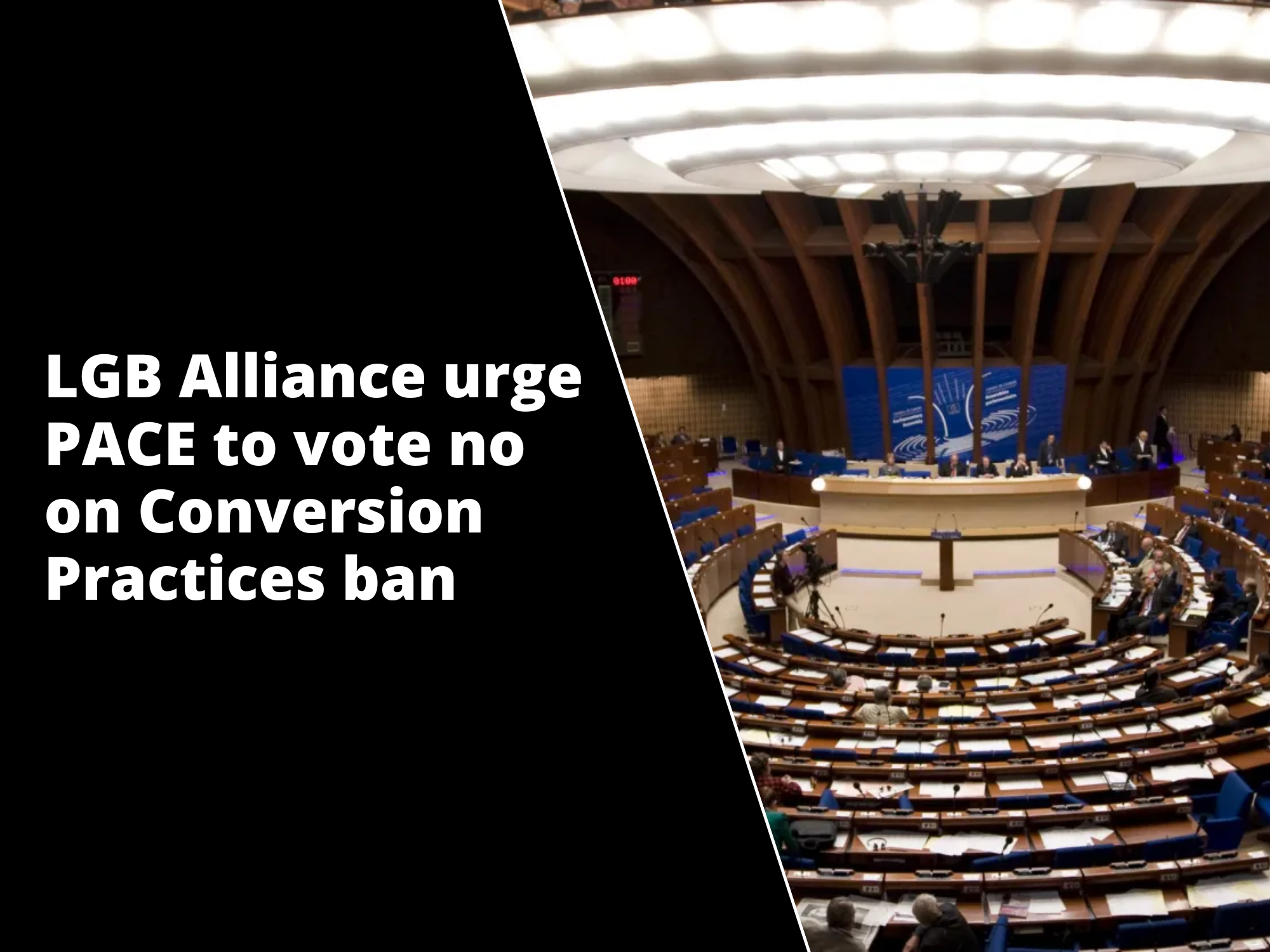
Today we have issued a statement to the Parliamentary Assembly of the Council of Europe (PACE) regarding the upcoming vote on the resolution For a ban on conversion practices (Doc. 15883) on 29 January 2026.
Download your copy here.
Why do so many lesbians, gay men and bisexuals say No to bans on “conversion practices” framed around gender identity and gender expression?
It is, undoubtedly, abhorrent to try to coerce gay people into becoming straight. These are vile practices that, fortunately, are already prohibited in most European countries and addressed under existing laws concerning violence, harassment, threats and intimidation. Where such protections are missing, they should be introduced. So why not ban these practices outright?
Because that’s not what so-called “conversion practices” bans are really about – not as soon as gender identity and gender expression are added. This inclusion changes the meaning entirely: what sounds like a ban on abusive practices becomes a mechanism to police how parents, professionals and public institutions respond to children who say they are the opposite sex.
If your daughter says she is a boy, you will want to ask her why she has come to that conclusion. Her teachers may want to ask her if she is ok. You may want to ask her what she has been watching online, or if someone has been persuading her that she is a boy. You may want her to have exploratory psychotherapy to find out the cause of her distress with her body.
A ban on conversion practices that includes gender identity and gender expression would expose those offering exploratory therapy to the risk of prosecution – for example, if a girl claims: “She doesn’t believe I’m a boy. She’s trying to convert me!”
Children and young people put on a medical pathway to appear as the opposite sex face lifelong medicalisation, sterility and serious health risks. These are overwhelmingly lesbian, gay and bisexual teens. They are not ill – and they do not need drugs or surgery to “be their true selves.”
-
- Studies consistently show that the majority of young people referred to gender clinics are in fact beginning to come to terms with being lesbian, gay or bisexual. The Cass Review confirmed this, citing data from the Tavistock GIDS clinic indicating that 89% of girls and 81% of boys referred were same-sex attracted.
-
- We are concerned that such bans will result in more same-sex attracted young people being put on a path toward irreversible medicalisation – including puberty blockers, cross-sex hormones and even surgery. Many of these children and adolescents who “identify” as the opposite sex or adopt a gender identity present with co-occurring conditions such as depression, anxiety, trauma or autism. They deserve holistic, compassionate care – not a fast track to lifelong medicalisation.
-
- We believe that a ban on “conversion practices” including gender identity and gender expression would have a chilling effect on therapists, parents, teachers, and social workers – even where legislation claims to include safeguards. Experience from countries like Australia shows these safeguards are ineffective in practice. Therapists who wish to provide neutral, exploratory psychotherapy would likely feel intimidated, fearing professional consequences, and may either be pressured into providing the “affirmative care” activists demand or avoid treating such patients altogether. Parents, teachers, and social workers may likewise feel unable to question or discuss a young person’s distress without fear of reprisal. This risks silencing those best placed to support vulnerable young people and undermines ethical, non-directive therapeutic care.
Bans on conversion practices framed around gender identity and gender expression hurt lesbians and gays by perpetuating the myth that some children are “born in the wrong body”, especially those who may appear to be “gender non-conforming”: sporty or masculine leaning girls and soft and sensitive boys. In fact, many will simply grow up to be lesbian, gay or bisexual.
Please stand with LGB Alliance and oppose the proposed ban.